NCyclicSymmetry
| Type: | int |
|---|---|
| Range: | [0, 2147483647] |
| Default: | -/- |
| Appearance: | optional |
Note
JCMsuite automatically scans over this parameter for scattering problem. This paramater is only required when one intentionally restricts the fields to a specific symmetry index.
The parameter NCyclicSymmetry selects the angular symmetry class of the solution.
In the presence of discrete rotational symmetries ( ) it is required to specify the phase relation of the electromagnetic field between adjacent symmetry sectors. A cyclic symmetry is defined by a rotation of angle
  around a given symmetry axis.
For such a rotation, the electromagnetic fields satisfy a Bloch-type periodicity condition. Let  denote the rotation operator. Then the fields fulfill
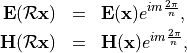
where  is the cyclic symmetry index.
The parameter NCyclicSymmetry corresponds to this index  and selects the angular symmetry class of the solution.
- NCyclicSymmetry = 0 corresponds to fully symmetric modes with identical fields in all sectors.
- NCyclicSymmetry > 0 introduces a phase shift between neighboring sectors and yields higher-order angular modes.
The cyclic symmetry index determines how the field transforms under rotation:
- For
 , the fields are invariant under rotation.
 - For
 , the fields acquire a phase factor, leading to rotating or twisting field patterns across the structure.
This is analogous to cylindrical coordinates, where represents the azimuthal mode number.
JCMsuite automatically detects the cyclic rotation angle from a given grid.jcm and enforces the above phase relation across these boundaries automatically based on the specified value of NCyclicSymmetry. In the layout.jcm cyclic symmetry is activated by assigning Class = Cn to the corresponding boundary segments. These boundaries then form a pair of interfaces related by the rotation operator.